Hiring · Apr 7, 2026
The Silent Leak in the Hiring Funnel
Applications alone do not guarantee a healthy funnel; the process often loses strong candidates before the hiring team can even evaluate them.
Author
Achin Agarwal
Published
Apr 7, 2026
Reading time
3 min read
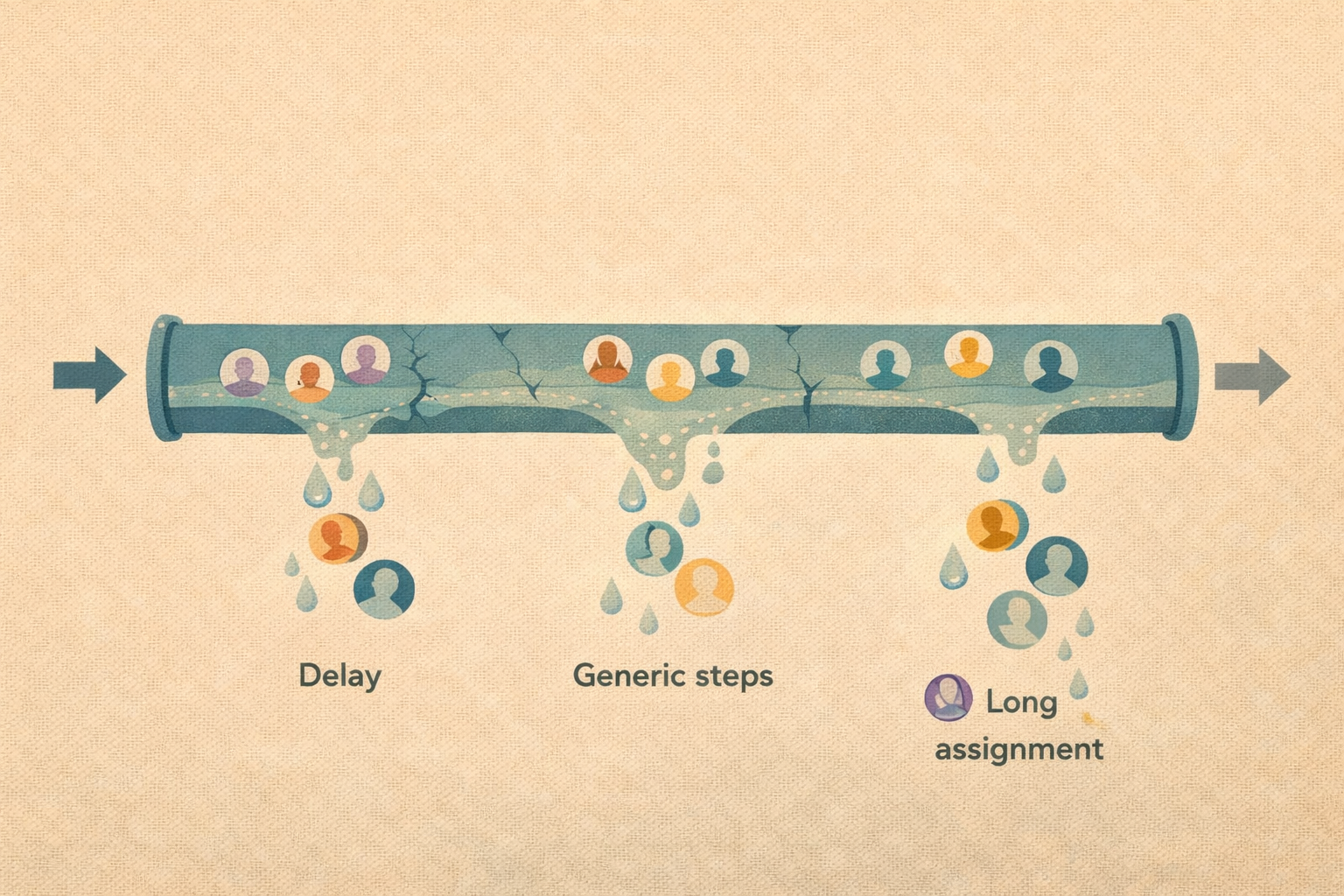
A founder I know was hiring for an operations role. The company had no shortage of interest. Applications came in steadily, the role seemed attractive, and on paper the funnel looked healthy.
And yet, a few weeks later, he said something that was far more revealing than he realized.
“We had plenty of applicants,” he said, “but by the end of the process it felt like there was no one worth hiring.”
At first, that sounds absurd. More applicants should improve your odds, not reduce them. But when we walked through the process step by step, the real problem became obvious.
The issue was not that strong candidates never applied. The issue was that the process kept losing them before the company had really understood who they were.
“In many hiring funnels, good candidates do not get rejected. They simply drift away before the company has learned enough to choose them.”
Why Good Candidates Quietly Disappear
When someone applies for a role, there is usually a short window in which their interest is at its highest. They are curious. Alert. Paying attention. They want to know what happens next.
That window does not stay open for long.
If the company goes quiet for several days, momentum fades. If the next step is confusing, enthusiasm drops. If the process starts feeling repetitive, slow, or generic, candidates begin to disengage. And the ones most likely to move on are often the ones with the most alternatives.
That is the part many teams miss. They think candidate drop-off is normal background noise. Often, it is not. Often, it is a signal that the process is creating friction faster than it is creating conviction.
How Funnels Start Leaking
In this case, nothing was dramatically broken. That was the trap.
Resumes were reviewed manually, so shortlisting took longer than it should have. The assignment sent to candidates was long and only loosely connected to the actual work. Scheduling took time. Internal feedback took more time. By the time the company was ready to move seriously, some of the most promising candidates had already accepted other offers.
No single step looked disastrous in isolation. But hiring funnels rarely fail in one dramatic moment. They fail through accumulation. A little delay here. A little uncertainty there. A little unnecessary effort in the middle. Put it all together, and the funnel starts leaking.
What Better Teams Understand
Hiring today is not just an evaluation problem. It is also an attention problem.
You are not simply trying to assess candidates. You are trying to keep the right ones engaged long enough to assess them properly. That changes how the funnel should be designed.
Strong teams have started to treat early-stage hiring less like administrative filtering and more like product design. They ask sharper questions. How quickly can we identify genuine fit? How early can we test real ability? How much unnecessary back-and-forth can we remove?
That is where the contrast becomes clear. Traditional early-stage hiring spends time before it creates insight. Better systems create insight early, so time is spent only where it matters.
Platforms like Xquizit are interesting for exactly this reason. Not because they promise some vague “automation of hiring,” but because they help teams get to practical, role-relevant signal much earlier. Instead of shuffling resumes around and stretching out coordination loops, the process can move faster toward structured evaluation. Candidates get clarity sooner. Teams get evidence sooner. And the funnel becomes far less likely to lose good people before the serious conversation has even begun.
In the end, hiring is not just about choosing the right person. It is about making sure the right people remain in your process long enough to be chosen.
Want to make the top of your hiring funnel sharper, faster, and harder to leak?
14-day free trial · No credit card required
Latest insights
View all insights →
The Interview Is the Last Place You Should Be Evaluating Someone
By Nandini Vashistha
Interviews were never meant to verify resumes and skills. When earlier stages do that work, hiring managers finally get to evaluate the person - not prove they belong in the room.
Read insight
Imagine If the Olympics Worked Like Hiring
By Nandini Vashistha
Resumes are training history, not the race. Fair hiring means the same rules, the same track, and evidence of who can actually do the job.
Read insight
The Hidden Cost of Traditional Hiring That Most HR Teams Never Measure
By Nandini Vashistha
The biggest hiring cost is not job boards or agency fees. It is waiting - and the great candidates who accept another offer before yours ever goes out.
Read insight© 2026 Xquizit. All rights reserved | ALGO ONE AI PRIVATE LIMITED